

Concrete estimating basics
Order the right yardage the first time.
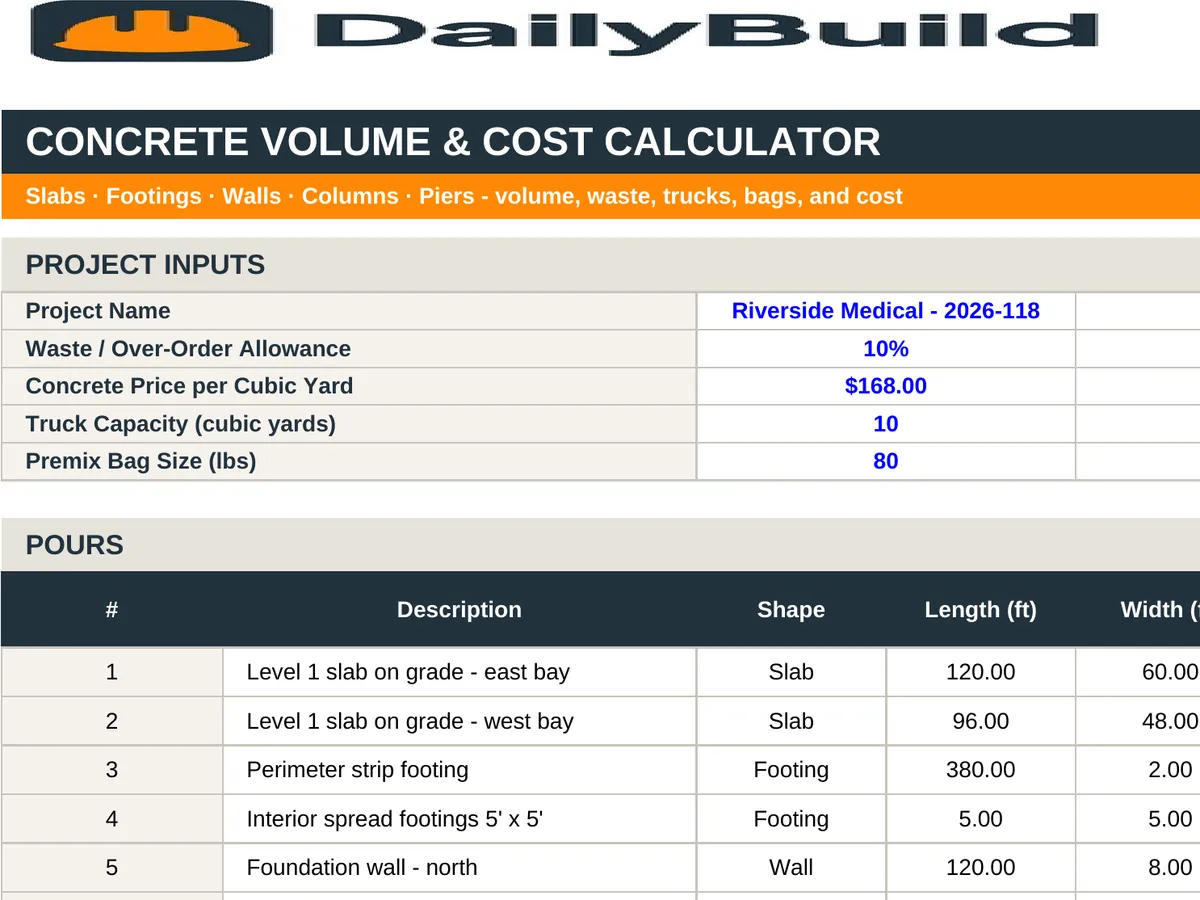
Concrete is sold by the cubic yard, and drawings are dimensioned in feet and inches. The conversion is simple - length x width x thickness in feet, divided by 27 - but doing it in your head across a dozen elements is exactly how short pours happen. This calculator does every conversion for you.
Always add a waste allowance
Subgrade irregularity, form deflection, spillage, and over-excavation all consume concrete. A 5% to 10% allowance is standard - lower on formed elements, higher on slab-on-grade over uneven subgrade. The template applies your percentage and shows both the calculated volume and the volume to order.
Rebar is priced by weight, not by bar
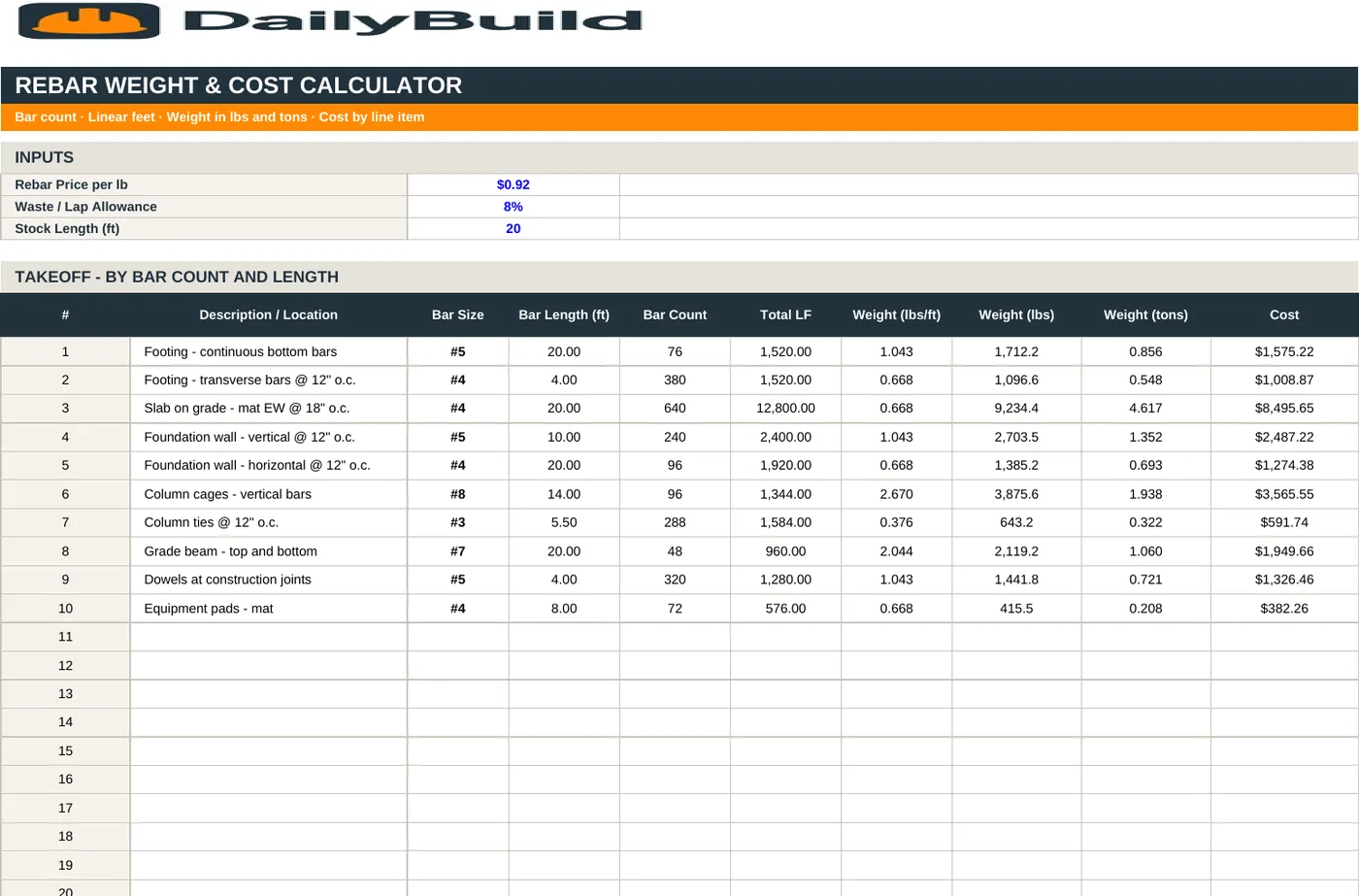
Reinforcing steel is bought by the pound or ton, so a takeoff has to convert bars into weight. Bar size gives weight per foot - a #4 is 0.668 lb/ft, a #5 is 1.043 lb/ft - and the calculator multiplies that by bar count and length to return pounds and tons. Bar counts can be derived directly from your spacing and run length.
Do not forget laps and hooks
Splice laps, hooks, and bends add real footage. Add your lap length to the bar length entry, or carry an allowance on top of the calculated linear feet. A takeoff computed from plan dimensions alone typically comes up short.
Truck loads determine the pour plan
A standard ready-mix truck carries roughly 8 to 10 cubic yards. Knowing the load count before the pre-pour meeting drives crew size, pump duration, and delivery spacing - and keeps you from discovering at 9 a.m. that the pour needs one more truck.